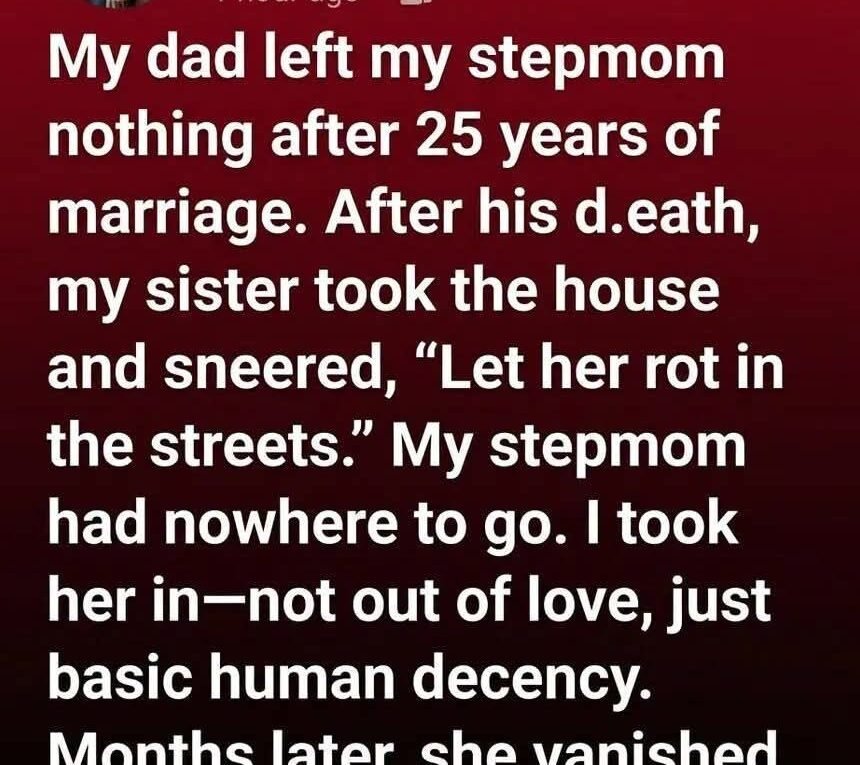
I Gave My Homeless Stepmother a Room — Then Her Final Gift Revealed What I Had Never Seen
Sandra sat perfectly still as the attorney finished reading my father’s will.
She didn’t argue.
She didn’t cry.
She didn’t even ask a single question.
She simply folded her hands in her lap and stared at the polished conference table as though the words had drained every ounce of strength from her body.
The silence in the room was heavier than grief itself.
My father had been gone for only a week.
For twenty-five years, Sandra had been his wife. She had cared for him through illnesses, celebrated holidays beside him, helped pay bills, maintained their home, and quietly stood beside him through every ordinary day that makes up a marriage.
Yet according to the documents the attorney placed before us, she had been left with… nothing.
Not the house.
Not the savings.
Not the investment accounts.
Not even a small financial cushion to help her start over.
Everything had already been transferred into my younger sister Emily’s name years before my father’s death.
Legally, there was almost nothing left in the estate.
Sandra’s entire life had been reduced to two aging suitcases sitting beside her chair.
She was sixty-three years old.
And by the end of the week, she would have nowhere to live.
The attorney looked genuinely uncomfortable.
“I’m very sorry,” he said quietly. “The property transfer was completed several years ago.”
Sandra forced a weak smile.
“I understand.”
But I wasn’t sure she did.
Or perhaps she understood all too well.
The meeting ended in painful silence.
As we walked into the parking lot, rain clouds gathered overhead.
Sandra stood beside the curb, clutching the handles of her suitcases, looking smaller than I had ever seen her.
Before I had a chance to say anything, Emily spoke.
“Well,” she sighed, checking her phone, “I guess that’s that.”
I stared at her.
“What do you mean?”
“Dad made his decision.”
“Sandra has nowhere to go.”
Emily shrugged.
“She’s not really our responsibility anymore.”
Those words hit me harder than anything I’d heard inside the lawyer’s office.
Not our responsibility.
This was the woman who had packed our school lunches after our mother died.
The woman who had attended every birthday, every Christmas morning, every family dinner for more than two decades.
She wasn’t perfect.
We’d never been especially close.
Neither of us had tried to force a mother-daughter relationship that neither felt naturally.
She never asked me to call her “Mom.”
I never did.
But she’d always been kind.
Quietly kind.
And now she was standing alone with everything she owned packed into two suitcases.
I looked at her.
“Come home with me.”
She blinked.
“Oh, no…”
“You’ll stay in my guest room.”
“I couldn’t possibly.”
“You can.”
“Only until I find somewhere affordable.”
“As long as you need.”
Her eyes immediately filled with tears.
“Are you sure?”
“I’m sure.”
She thanked me once while loading her luggage into my car.
Again as we reached my house.
And a third time as I carried her bags into the guest room.
“I won’t be any trouble,” she whispered.
“You don’t have to worry about me.”
Over the following months, I realised she truly meant those words.
Sandra lived so quietly that some days I almost forgot another person shared the house.
She woke before I did each morning.
Made her bed with military precision.
Cooked simple, inexpensive meals using ingredients she bought herself whenever she could.
She washed every plate immediately after eating.
Folded blankets.
Watered my plants.
Even replaced empty toilet paper rolls before I noticed they were gone.
Every month, when her small survivor’s benefit of just **$430** arrived, she insisted on contributing.
“Please,” she’d say, sliding a few folded bills across the kitchen table.
“I need to pay something.”
I always pushed the money back.
“You need it more than I do.”
She never argued.
She simply smiled softly and tucked the money back into her purse.
Occasionally, I’d find her standing quietly in the hallway looking at the framed photographs from my childhood.
Pictures of school plays.
Birthday parties.
Graduation.
My first bicycle.
Whenever she realised I’d noticed, she’d quickly turn away.
“I’m sorry,” she’d murmur.
“I was just remembering.”
Remembering what?
I almost asked dozens of times.
For some reason, I never did.
Then one rainy Thursday evening, everything changed.
I came home from work expecting to smell Sandra’s vegetable soup simmering on the stove.
The house was silent.
The guest room door stood open.
The bed had been perfectly made.
The wardrobe was empty.
Her shoes no longer sat neatly beside the door.
The room looked exactly as it had before she’d ever moved in.
At first I thought she’d gone shopping.
Hours passed.
Night fell.
She didn’t return.
I called her mobile phone.
Disconnected.
I contacted nearby shelters.
Nothing.
Churches she’d occasionally attended.
Nothing.
The few distant relatives whose names I knew.
No one had seen her.
It was as though she’d simply stepped out of my life without leaving footprints behind.
Late that night, while searching my desk for an insurance document the police requested, I noticed a large envelope tucked beneath my paperwork.
My name was written neatly across the front in Sandra’s unmistakable handwriting.
Inside were dozens of photographs.
I spread them across my desk.
My hands began trembling almost immediately.
There I was at six years old, proudly holding my science fair ribbon.
Another photograph showed my first lead role in a school play.
Then my high school graduation.
University orientation.
My college graduation ceremony.
Birthdays.
Recitals.
Sporting events.
Christmas mornings.
Every major milestone of my life.
I stared at them in disbelief.
Then something else struck me.
These weren’t photographs copied from family albums.
They had been taken from angles no one else could have captured.
Sandra had been behind the camera.
All those years…
After my mother died…
She had quietly attended every important moment of my life.
Never stepping into the spotlight.
Never trying to replace the woman I’d lost.
Simply standing behind the lens, making sure someone preserved the memories.
I’d spent years believing she kept her distance.
In reality, she’d been there all along.
Just outside the frame.
At the bottom of the envelope rested a small velvet pouch.
Inside lay an antique ring set with a deep blue gemstone surrounded by tiny diamonds.
A jeweller later valued it at almost **$9,000**.
Folded beneath it was a handwritten note.
*”This is the only investment I still have.*
*Your father gave it to me many years ago.*
*If life ever becomes difficult, sell it without guilt.*
*You’ve already given me more kindness than I ever expected.*
*Thank you for giving me a place that felt like home.*
*Love, Sandra.”*
I couldn’t breathe.
The next morning, I hired an attorney.
I filed a missing-person report.
I searched property records, court filings, mortgage databases, and every address connected to my father’s estate.
I contacted hospitals.
Care facilities.
Old neighbours.
Former employers.
Every lead disappeared almost as quickly as it appeared.
There were no recent bank withdrawals.
No rental agreements.
No utility accounts.
No forwarding address.
Nothing.
It was as though Sandra had carefully erased every trace of where she’d gone.
Years have passed since that day.
I still don’t know whether she left because she feared becoming a burden…
…or because there was somewhere she needed to face alone.
Eventually, Emily admitted something that changed how I saw everything.
Our father had transferred nearly all of his property into her name years earlier.
Sandra hadn’t known.
She’d believed they were financially secure.
By the time she discovered the truth, there was nothing left to contest.
The betrayal hadn’t happened after his death.
It had happened long before it.
Today, the photographs remain in a carved wooden box on my bookshelf.
Whenever life feels uncertain, I wear Sandra’s ring.
Not because of its value.
Because it reminds me of something priceless I failed to see while I still had the chance.
For years, I mistook her silence for emotional distance.
I thought her careful respect for my mother’s memory meant she didn’t truly love me.
Now I understand that real love doesn’t always announce itself.
Sometimes it quietly packs your school lunch.
Sometimes it applauds from the back row.
Sometimes it stands behind the camera so you can be the centre of every photograph.
The greatest regret I carry isn’t that Sandra disappeared.
It’s that I only recognised how deeply she had loved me after she was gone.
If she is still somewhere out there, I hope she knows something I never said often enough.
She was never simply my stepmother.
She was family.
And long before she quietly left that guest room…
It had already become her home.