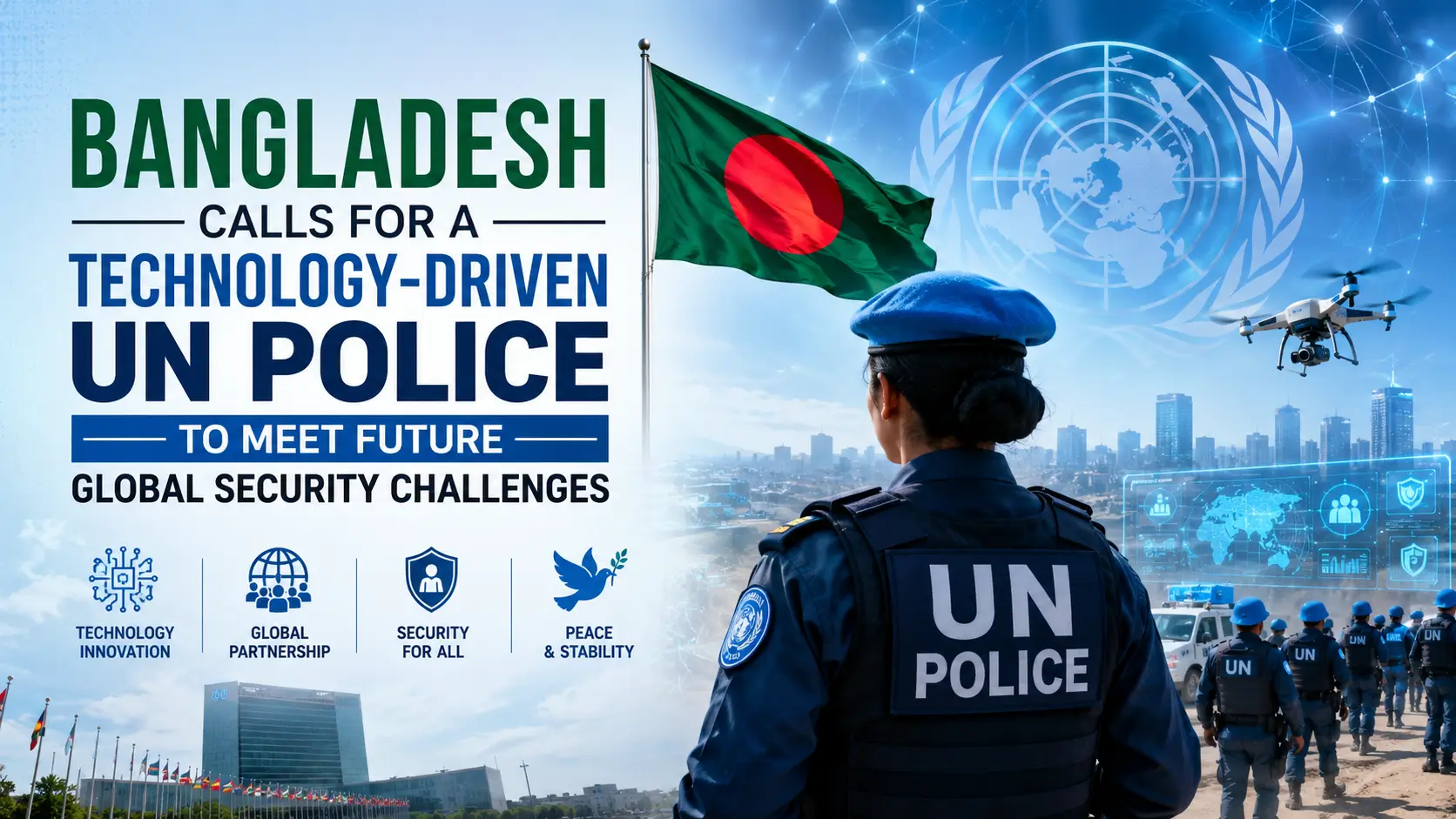
Bangladesh Calls for a Technology-Driven UN Police to Meet Future Global Security Challenges
Technology-Driven UN Police. Bangladesh has urged the United Nations to modernize its policing framework by adopting advanced technology, improving innovation, and strengthening international cooperation to address the rapidly evolving global security landscape. Speaking at the 5th United Nations Chiefs of Police Summit (UNCOPS) 2026 held at the United Nations Headquarters in New York, Bangladesh’s Minister of Home Affairs, Salahuddin Ahmed, emphasized that the future of international peacekeeping depends on building a smarter, more adaptable, and technology-powered UN Police force.
The summit brought together police leaders, security experts, and government representatives from around the world to discuss the future of United Nations policing and peacekeeping operations. As global security threats continue to evolve, Bangladesh highlighted the importance of preparing the UN Police with modern tools, specialized training, and innovative strategies to effectively respond to new challenges.
Bangladesh Urges Reform of UN Police
During his keynote address, Minister Salahuddin Ahmed stressed that traditional policing methods are no longer sufficient to tackle today’s increasingly complex security issues. He stated that the world is facing new forms of crime, including cybercrime, transnational criminal networks, terrorism, organized crime, and climate-related security risks. These threats require a modern policing approach supported by advanced technology and international collaboration.
The minister delivered a powerful message by saying, “Tomorrow’s security challenges cannot be addressed with yesterday’s capabilities.” His statement reflected Bangladesh’s belief that the United Nations must continue reforming its peacekeeping and policing operations to remain effective in a rapidly changing global environment.
Importance of Technology in Modern Peacekeeping
Bangladesh strongly advocated for greater investment in technology to strengthen UN Police operations worldwide. According to the minister, artificial intelligence, digital surveillance systems, data analytics, cybersecurity tools, and modern communication technologies can significantly improve the effectiveness of peacekeeping missions.
Technology enables police officers to gather intelligence more efficiently, monitor conflict zones, prevent criminal activities, and respond more quickly to emergencies. Bangladesh believes that integrating these innovations into UN policing operations will enhance both operational efficiency and the safety of peacekeepers deployed in high-risk areas.
The government also emphasized that technology should complement well-trained personnel rather than replace them. Skilled officers equipped with modern technological tools can better manage complex peacekeeping missions while protecting vulnerable communities.
Investing in Skilled Police Personnel
Alongside technological advancement, Bangladesh highlighted the need for increased investment in highly trained police officers and specialized expertise. The minister noted that international criminal organizations have become more sophisticated, often operating across multiple countries using advanced technologies.
To effectively counter these threats, UN Police officers require continuous professional development, specialized training, and access to the latest investigative techniques. Bangladesh encouraged the United Nations to prioritize capacity building, leadership development, and technical education for police personnel participating in peacekeeping missions.
Such investments, the minister argued, would ensure that peacekeepers remain prepared for emerging security challenges while maintaining public trust in conflict-affected regions.
Bangladesh Contribution to UN Peacekeeping
Bangladesh has long been recognized as one of the largest contributors to United Nations peacekeeping operations. Over the years, thousands of Bangladeshi police officers and peacekeepers have served in various conflict zones across Africa, Asia, and other regions under the UN flag.
During the summit, Minister Salahuddin Ahmed highlighted the reforms undertaken by Bangladesh to modernize its own police force. These reforms aim to improve operational readiness, strengthen professional standards, and prepare officers for increasingly complex peacekeeping responsibilities.
The minister stated that Bangladesh remains fully committed to supporting international peace and security while continuously improving the capabilities of its police personnel through training, modernization, and institutional reforms.
Proposal for a UN Police Knowledge and Innovation Network
One of the key proposals presented by Bangladesh during the summit was the establishment of a UN Police Knowledge and Innovation Network. This initiative would create a global platform where member states can regularly exchange knowledge, innovative policing techniques, operational experiences, and best practices.
The proposed network would encourage collaboration among police organizations from different countries, allowing them to learn from successful peacekeeping missions and adapt proven strategies to local contexts.
Bangladesh believes that stronger information sharing will improve decision-making, enhance operational efficiency, and foster innovation across all UN Police missions.
Climate Change Recognized as a Security Challenge
Another major issue highlighted by Bangladesh was the growing impact of climate change on global security. Extreme weather events, natural disasters, displacement of populations, food insecurity, and resource conflicts are increasingly contributing to instability in many parts of the world.
Recognizing these risks, the minister proposed organizing an Annual Conference on Environment and Policing. The conference would focus on strengthening international cooperation, sharing research, and developing practical strategies to help police organizations respond effectively to climate-related security challenges.
Bangladesh argued that environmental issues should no longer be viewed solely as ecological concerns but also as important factors influencing peace, stability, and public safety.
Strengthening International Cooperation
Bangladesh emphasized that no single country can address today’s global security challenges alone. International cooperation remains essential for combating terrorism, cybercrime, human trafficking, organized crime, and other transnational threats.
The country encouraged UN member states to work more closely by sharing intelligence, conducting joint training exercises, adopting innovative policing technologies, and supporting collaborative research initiatives.
Greater cooperation, Bangladesh believes, will enable the United Nations to respond more effectively to emerging crises while strengthening trust among participating countries.
Conclusion
Bangladesh’s proposals at the 5th United Nations Chiefs of Police Summit 2026 demonstrate the country’s commitment to advancing international peacekeeping through innovation, modernization, and cooperation. By advocating for technology-driven policing, investment in skilled personnel, knowledge-sharing networks, and climate-focused security initiatives, Bangladesh has outlined a forward-looking vision for the future of UN Police.
As global threats continue to evolve, the need for a more adaptive and technologically advanced UN Police force becomes increasingly important. Bangladesh’s recommendations provide a practical roadmap for enhancing peacekeeping capabilities while ensuring that United Nations policing remains effective, resilient, and prepared for the challenges of tomorrow