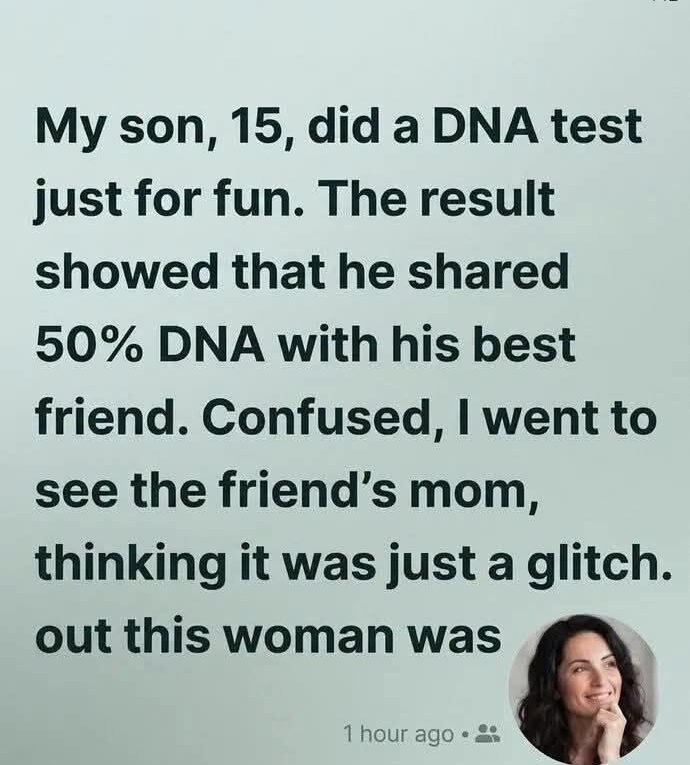
My Son Took a DNA Test for Fun — The Results Uncovered a Family Secret No One Expected
My hands went cold the moment I saw the words on Ethan’s phone.
My fifteen-year-old son had never been particularly interested in family mysteries. He was the kind of kid who cared more about soccer practice, video games, and whether there was anything good left in the refrigerator than about where his ancestors had lived three hundred years ago. So when he told me he and his best friend, Caleb, had each bought a $99 DNA ancestry kit, I thought nothing of it.
They had turned the whole thing into a joke.
For weeks, the boys had teased each other about who would discover some dramatic European royal connection or some distant Scandinavian relative. Ethan predicted he would find Viking ancestry. Caleb insisted Ethan would probably discover he was “fifty percent potato.” I remember laughing when they mailed the kits away, never imagining that a simple experiment between two teenagers would uncover a secret their parents had carried for fifteen years.
Then the results arrived.
It was a Saturday afternoon when Ethan came rushing into the kitchen, his phone in his hand and an expression on his face I had never seen before.
“Mom,” he said slowly, “something’s wrong.”
I wiped my hands on a towel and looked over his shoulder.
At first, the report meant almost nothing to me. There were percentages, genetic matches, family trees, and unfamiliar terms. Then I saw the relationship prediction.
Possible relationship: half-sibling.
I stared at the screen.
Then I refreshed the page.
The result remained.
I refreshed it again.
Still there.
“That has to be a mistake,” I whispered.
Ethan looked at me. “But Caleb got the same thing.”
My stomach dropped.
The two boys had been best friends since elementary school. They had played on the same teams, spent weekends at each other’s houses, shared inside jokes, and practically treated one another like brothers.
But according to the DNA results, they might actually be brothers.
Half-brothers.
I looked at their pictures side by side on Ethan’s phone. Suddenly, details I had never paid attention to seemed impossible to ignore. They had similar eyes. The same crooked grin when they were trying not to laugh. Even the same habit of tilting their heads slightly when they were confused.
And then a memory came rushing back.
My husband had once told me that before we met, he had briefly dated Caleb’s mother, Julia.
It had never seemed important. Their relationship had ended long before our marriage, and Julia had eventually moved on. I knew she had raised Caleb alone, but I had never had a reason to question who his biological father was.
Now, fifteen years later, that forgotten piece of history suddenly felt enormous.
I called Julia.
When I showed her the results, she didn’t look shocked.
That frightened me more than anything.
She sat silently for several seconds before finally saying, “I always wondered if this day would come.”
Julia explained that after her relationship with my husband ended, she discovered she was pregnant. She had considered contacting him but ultimately decided against it. She said she was young, frightened, and convinced she could raise Caleb herself. Later, when my husband and I built our life together, she didn’t want to interfere.
Then something neither of us could have predicted happened.
Our sons met.
They became friends completely on their own.
No adult had arranged it. No one had told them about their shared history. They simply clicked.
Julia said she had spent years wondering whether Caleb would ever ask questions about his biological father. She had always known the truth, but she had never wanted to drop it into his life without knowing whether he was ready.
Then she looked at me and quietly said, “Caleb has wondered about his father for as long as I can remember.”
I felt a heaviness settle over me.
Because Caleb wasn’t just Ethan’s best friend anymore.
He might be my husband’s biological son.
And he had spent fifteen years growing up without knowing it.
When I returned home, the atmosphere was completely different.
My husband sat at the kitchen table staring at the DNA report. Ethan was unusually quiet. Caleb wasn’t there, but his name seemed to fill every corner of the room.
There were suddenly hundreds of questions.
Was the test accurate?
Should we order another test?
What would this mean legally?
What would it mean emotionally?
Should my husband tell Caleb immediately?
Would Caleb even want a relationship with him?
And what would happen to the friendship between the boys if the adults handled everything badly?
For a brief moment, practical concerns began flooding into the conversation. We wondered whether the discovery could eventually affect medical histories, insurance records, estate planning, inheritance, or other family responsibilities. There were questions about old financial obligations and whether legal parentage would ever need to be addressed formally.
But then Ethan asked the simplest question of all.
“Can Caleb still come over tomorrow?”
Everyone went silent.
That question changed the way I saw everything.
The boys hadn’t caused this.
They hadn’t lied.
They hadn’t betrayed anyone.
They had simply sent away two little tubes of saliva because they thought it would be fun to discover where their ancestors came from.
Instead, they had discovered that the friendship they valued might have been built on a biological connection none of them knew existed.
We decided not to make any rushed decisions.
Additional testing was arranged to confirm the result, and the adults agreed that any legal questions should be handled carefully and privately rather than turning the teenagers’ lives into a courtroom drama.
My husband also knew that if the results were confirmed, he couldn’t simply walk into Caleb’s life and demand to be called “Dad.”
Caleb was fifteen.
He deserved honesty, but he also deserved time.
When the confirmation finally came, there was no escaping the truth.
My husband was Caleb’s biological father.
For several days, everyone struggled with what that meant.
My husband carried guilt over the years he hadn’t known about his son. Julia carried the weight of having kept the truth to herself. I struggled with the realization that a part of my family’s history had existed just outside the boundaries of everything I thought I knew.
And the boys?
They handled it in the most unexpected way.
They laughed.
Not because it wasn’t serious, but because after fifteen years of being best friends, discovering they were half-brothers somehow explained things they had never been able to explain.
Why they could spend an entire weekend together without getting tired of each other.
Why they understood each other’s jokes instantly.
Why their arguments never seemed to last.
Why their families had always felt strangely familiar.
Eventually, my husband sat down with Caleb and told him the truth himself.
He didn’t make excuses.
He didn’t ask for forgiveness.
He simply told him that he wished he had known.
Caleb listened quietly.
Then he asked one question.
“Can we start now?”
My husband cried.
So did Julia.
So did I.
The months that followed weren’t magically easy. There were uncomfortable conversations and moments when emotions became overwhelming. Caleb needed space. My husband had to learn how to build a relationship with a teenager who had spent his entire childhood without him. Julia had to adjust to seeing a man from her past become part of her son’s present.
But slowly, something beautiful began to happen.
My husband started showing up.
Not with grand promises or expensive gifts, but with ordinary things.
He attended Caleb’s games.
He learned what music Caleb liked.
He helped with homework.
He listened.
And he never tried to erase the years he had missed. He simply tried to make the years ahead better.
Meanwhile, Ethan never treated Caleb differently.
One afternoon, I overheard them arguing over a video game in the living room.
“You’re cheating!”
“I literally beat you fair and square!”
“You’re my brother. You’re supposed to let me win!”
There was a pause.
Then both boys burst out laughing.
I stood in the kitchen listening to them and realized something.
The DNA test hadn’t created a family.
It had revealed one.
For fifteen years, the truth had existed quietly beneath ordinary life. Two boys had found each other without knowing why their friendship felt so natural. A mother had carried a difficult secret. A father had unknowingly missed an entire chapter of his child’s life.
And a $99 ancestry test had finally brought all of those hidden pieces into the same room.
I used to think family was defined by the stories we told about where we came from.
Now I understand that sometimes family is also the truth waiting quietly beneath those stories.
The test changed our understanding of the past.
But it didn’t have to destroy our future.
If anything, it gave us a chance to build something none of us had known was missing.
Disclaimer: This article is a dramatic work of creative fiction intended for entertainment and storytelling purposes. Any resemblance to real persons, living or dead, or actual events is purely coincidental.